
Social Impact
Social Impact
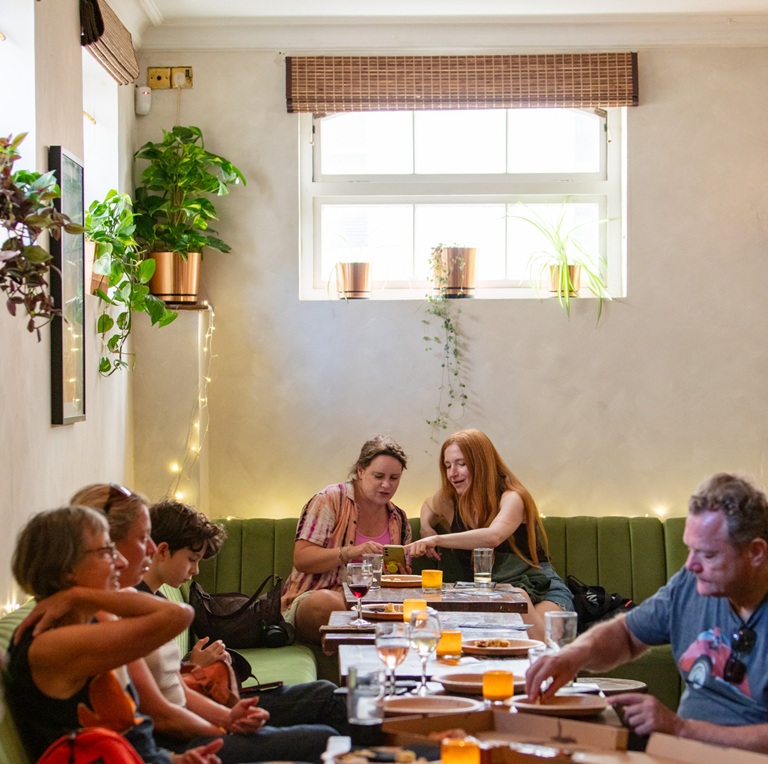
Every product we specify has a human story behind it: the people who mine, grow or manufacture it, the communities living next to that production, and the occupants who will spend years of their lives around it. Social impact deserves the same rigour we apply to environmental impact, from supply chain equity to the health of the spaces we create.
Facts
- People spend a substantial proportion of their lives indoors — often 80–90% — so indoor environments represent a significant share of our lifetime exposure to pollutants. SOURCE
- Research based on nearly 20,000 people in England, found that at least 120 minutes of nature contact a week is associated with a 59% higher likelihood of reporting good health and 23% higher wellbeing — regardless of whether it's one long visit or several shorter ones. SOURCE: University of Exeter (White et al., 2019),
- A global study of over 7,600 office workers across 16 countries found that those in environments with natural elements reported 15% higher wellbeing, 6% higher productivity and 15% greater creativity than those in conventional offices .SOURCE
- UK Green Building Council research found that employees with good access to daylight reported 18% fewer sick days than those with limited access.
- In 2026, the HSE launched a national inspection drive targeting 1,000 UK stone worktop fabricators, after dry-cutting engineered stone was found to expose workers to silica dust levels five to ten times higher than wet methods — a leading cause of the fatal lung disease silicosis.
- Around half of Rajasthan's estimated two million stone quarry workers are reported to suffer from silicosis or other respiratory disease; studies of South Indian granite quarries have found roughly 10% of labourers to be children, with 50–60% bonded through debt.
Health and Wellbeing
Consider the health impacts of a product across its entire lifecycle, not just once it's installed. That means asking what happens during extraction and manufacture, who is exposed to VOCs or dust during application (the health of the decorator matters as much as the health of the end user), and what a material sheds into air, water or soil once in use and at end of life. Use third party certifications and Health Product Declarations (HPD) to determine healthier specifications.
The evidence for this is no longer anecdotal. UK research has found that just two hours of nature contact a week — however it's accumulated — is linked to meaningfully better self-reported health and wellbeing, and international workplace studies consistently link natural elements, daylight and greenery to higher wellbeing, creativity and productivity, and fewer sick days. That reframes daylight, planting, natural materials and views out as performance specification, not decoration.
Biophilic design brings together beauty and science to increase a building's connection to nature for occupants through spatial design, mechanical and electrical design and material selection. Practically, that means daylight and views of nature, good air quality and ventilation, appropriate acoustics, and materials chosen with their full toxicity profile in mind — not just their appearance.
Air quality
- Verify that airflow is sufficient. When specifying mechanical extraction, assess the quality of external air and determine if filtration is necessary before it enters the interior
- Scrutinize materials and textiles for off-gassing potential, specifically looking for VOCs in paints and soft furnishings that impact long-term atmospheric health
- Prioritise the health of everyone in the supply and installation chain. Specification should account for high exposure levels during paint application; the decorator's respiratory safety is as vital as that of the final occupant
- Identify whether appliances or machinery emit hazardous particulate matter (PM10 and PM2.5) into the breathable environment
- Select materials that foster biophilic connection, such as visible timber grains, to improve psychological wellbeing
Natural Light
- Maximise daylight access to bolster occupant health and decrease reliance on carbon-intensive artificial illumination. Amplify natural sources wherever the floorplan allows
- Mitigate seasonal overheating from expansive south-facing glazing through strategic placement, high-performance solar treatments, or specified window coverings
Artificial Light
- Ensure illumination levels are fit for purpose. Design with task-specific layers that respond to different users and changing times of day
- Empower users with intuitive controls; integrate smart systems, timers, and accessible switching to manage the lit environment effectively
- Consider dynamic lighting that mirrors natural circadian rhythms, adjusting intensity and temperature throughout the day
- Prioritise high-efficiency LED technology over traditional halogen or incandescent bulbs to minimize energy consumption.
Comfort
- Manage acoustic performance to suit the room's function. Specify soundproofing or attenuation for equipment to maintain a healthy auditory environment
- Utilise smart building controls to harmonise indoor thermal comfort with operational energy efficiency
- Address visual and thermal discomfort by assessing material reflectivity and solar gain to prevent glare and temperature extremes
Cleaning / Maintenance
- Specify high-touch hardware and surfaces that are designed for easy sanitisation and long-term durability in shared spaces
- Evaluate the lifecycle impact of necessary cleaning regimes; ensure that specified maintenance products are ecologically benign and safe for those living in the space
Use frameworks to support occupant health and wellbeing:
- Living Building Challenge International Living Future Institute's seven "petals" of Place, Water, Energy, Health & Happiness, Materials, Equity and Beauty. Considered together, they remind us that a well-specified space is judged not only on its ecological footprint but on how just, healthy and beautiful it is for everyone touched by it. Practically, this means daylight and views of nature, good air quality and ventilation, appropriate acoustics, and materials chosen with their full toxicity profile in mind — not just their appearance.
- WELL Building Standard gives us a measurable framework for occupant health that is organised around ten concepts: Air, Water, Nourishment, Light, Movement, Thermal Comfort, Sound, Materials, Mind and Community — each addressing a distinct, evidence-based aspect of how a building affects the people in it.
- Building Biology is an approach that emphasises the use of non-toxic, natural materials, and aims to minimize exposure to harmful electromagnetic fields (EMFs), chemicals, and other environmental stressors.
- Fitwel healthy building certification system to integrate health and wellbeing into buildings to optimise buildings and support occupant health and productivity
Supply Chain Impacts
The people producing our materials — often in countries with weaker labour protections — deserve the same consideration as our clients and occupants. Certification schemes such as GoodWeave (addressing child labour in rug and carpet production) and labels like FSC and The Just Label, which scores organisations on socially just and equitable operations, give us practical ways to ask better questions of suppliers.
Grace Farms Foundation's Design for Freedom Toolkit takes this further, mapping forced and child labour risk across twelve at-risk material categories commonly used in interior design — including natural stone, brick, glass, steel, timber and textiles — alongside relevant certifications and questions to put to suppliers.
Community Impacts
Healthy Materials Lab uses the term 'fenceline communities' for neighbourhoods living alongside industrial and chemical production. It's a useful lens for interior design specifically, because so many of the materials specified in this sector are extracted or processed a long way from the projects they end up in.
Rajasthan's sandstone and granite quarries — a major source of the stone used globally in worktops, tiles, cobbles and garden paving — are a stark example. Around half of the state's estimated two million quarry workers are reported to suffer from silicosis or other respiratory disease from cutting and polishing stone with little protective equipment, and studies of South Indian granite quarries have found roughly 10% of labourers to be children, with 50–60% bonded to quarries through debt. Some UK stone suppliers have responded by developing ethically-audited ranges sourced through the Ethical Trading Initiative, which is worth asking about at specification stage.
Extraction and manufacturing impact communities and the biodiversity that supports them - but also where materials and chemicals end up after use phase is something our industry needs to be aware of and prevent.
Countries with little or no laws to protect humans or the environment are the places where this ‘waste’ ends up as a problem for someone else. Polluting environments that communities live by and eat from. Whether textiles in Chile's Atacama Desert or plastic in the environment and oceans. After packaging, the construction sector is the biggest polluter - using 20% of all plastic produced.
Key Points
- Assess products across the whole lifecycle: extraction, manufacture, application, occupation and disposal — not just the finished item.
- Red List: Ask suppliers whether products contain chemicals of concern (the Red List is a useful reference) and request low- or zero-VOC alternatives.
- Consider the health of tradespeople and installers, not only end users, when specifying finishes and application methods.
- Use frameworks such as the LBC's seven petals or WELL, Fitwel and Building Biology standards to think beyond environmental impact to human impact.
- Ask about labour conditions in supply chains — certifications offer a starting point, not a full guarantee.
- In the UK, confirm if the supplier or manufacturer is a certified Living Wage employer.
- Scrutinise sustainability policies for evidence-based commitments rather than vague statements.
- Fair Trade: Prioritise the specification of products from Fair Trade certified sources.
- Legislation Verify whether the organisation maintains an active Modern Slavery Act policy or disclosure.
- Bonded labour: Be aware that textiles and mining remain high-risk categories for debt bondage and exploitative labour practices.
- Certifications: Utilise the GoodWeave certification scheme to mitigate risks of child or adult exploitation in supply chains.
Resources
- Healthy Materials Lab resources:
Website - courses and resources https://healthymaterialslab.org
Materials collections https://healthymaterialslab.org/material-collections
How to read a HPD https://s3.us-east-2.amazonaws.com/prod-hml/resources/2022.02.25_HML_6stepsHPD-fullguide_v3.pdf
Podcast https://healthymaterialslab.org/projects/podcast - Grace Farm Foundation’s Design for Freedom resources: https://www.designforfreedom.org/additional-resources/
- Red List https://living-future.org/red-list/
- GoodWeave https://goodweave.org/uk/
- Ethical Trading Initiative https://www.ethicaltrade.org/
- Built Environment Declares — Child Labour and Modern Slavery Guidance July 2026
- Living Product Challenge (International Living Future Institute) Certification program that encourages the creation of socially responsible products inspired by nature, aiming to be regenerative, healthy, and environmentally beneficial throughout their lifecycle.
- The Just Label — International Living Future Institute https://living-future.org/just/
- Changing Streams Research Centre (plastic in construction) https://www.liverpool.ac.uk/environmental-sciences/centres-and-institutes/changing-streams/